
Madison County Criminal Court Cases
Madison County criminal court cases do not sit in one shared file system. The 12th and 278th Judicial District Courts hear felony matters and other cases within district jurisdiction. District Clerk Rhonda Savage keeps those files at the courthouse. The constitutional Madison County Court handles its assigned county-level criminal docket, including applicable misdemeanors, and County Clerk Adrian Lawson is the record custodian for that work. Justice of the Peace and municipal courts retain their own fine-only or city matters. The court named on a citation, bond paper, or cause number is therefore the first clue to the right office.
The filed case tells more than a jail entry. A clerk file can show the complaint, information or indictment, plea, motions, settings, orders, disposition, judgment, sentence, costs, and later revocation or appeal activity. Prosecutors may reject or change the charge that appeared at booking. For that reason, a Madison County court judgment is the best source for the result of a prosecution. The broader Madison County criminal history overview explains how the court file connects to sheriff and Texas DPS records.
Madison County Felony Files
The District Clerk's official page is the local starting point for felony criminal case records. The counter is in Room 226 of the Madison County Courthouse, 101 West Main Street, Madisonville, TX 77864. Call 936-241-6212 or fax 936-349-1893. A requester should provide a cause number when possible. With no number, give the legal name and an approximate filing or arrest date, then ask staff to identify the district court and available inspection or copy choices.
The District Clerk page separates links for the two district benches. That matters because both courts serve Madison County, yet the caption and court assignment still control the file. The office can locate filed pleadings, settings, judgments, and copies. It cannot make a jail charge final or fill gaps in another agency's report. Before ordering a certified record, tell the clerk which document is needed, such as a judgment, dismissal, indictment, or docket sheet, and request the current fee.
The official District Clerk source also shows the public court links used for Madison County felony cases.
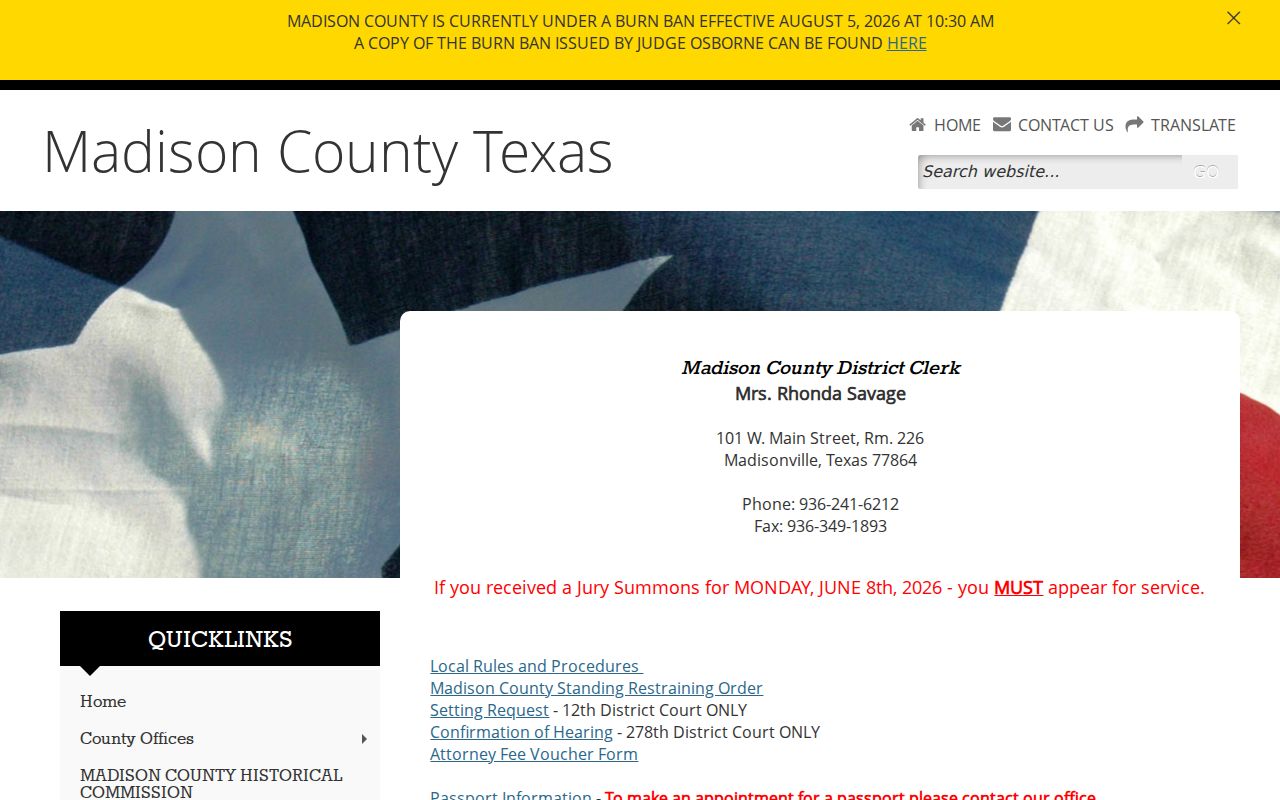
The captured office page points readers to the correct clerk before they rely on a partial statewide search result.
Searching Madison County Case Records
No free Madison County branded defendant search was found on the county site. Begin with the responsible clerk, then use re:SearchTX as a statewide case and document layer. Its coverage, account access, role permissions, and document charges vary. A sealed item will not become public merely because the system receives electronic filings. Follow this sequence to search Madison County case records without mixing courts.
- Identify the court level from the charging paper, citation, bond record, or likely offense class. Felonies go to the District Clerk; county misdemeanors start with the County Clerk.
- Search re:SearchTX by exact case number when known. Otherwise use the party name and narrow to Madison County, the criminal case type, and a useful filed-date range.
- Review the court, status, events, hearings, charge, disposition, financial entries, and visible documents. Do not assume every field or document is free or public.
- Call the correct Madison County clerk when the online result is absent or thin. Ask for the cause number, court assignment, inspection options, and a cost estimate.
- Order the specific court document needed. A certified judgment or dismissal is more reliable than a search-screen summary when proving the outcome.
| Search control | Type | Required | Notes |
|---|---|---|---|
| Case number | Text | One route | Best exact identifier |
| Party or person name | Text | Alternate route | Spelling and name changes can cause misses |
| Court or county | Filter | Optional | Select Madison County and the proper court |
| Case type | Filter | Optional | Choose criminal when available |
| Filed-date range | Date filter | Optional | Helps narrow common names |
| Search | Button | Yes | An account or session may be required |
| Sort and results | List controls | N/A | Controls depend on the result set |
Madison County Clerk Routes
Choosing between clerks is more important than choosing a search box. District Clerk staff maintain felony filings in the two district courts. County Clerk staff maintain the constitutional County Court's criminal files. The County Clerk office is at 103 W. Trinity Street, Suite 104, Madisonville, TX 77864, not inside the courthouse address used by the District Clerk. Its phone is 936-241-6210 and fax is 936-241-6211.
Posted County Clerk hours are Monday through Friday, 8:00 a.m. to 12:30 p.m. and 1:30 to 4:30 p.m., excluding county holidays. The midday closure can derail an unplanned record visit. Call ahead and ask which staff member handles criminal copies, whether inspection is available, and what the current fee schedule requires. Do not carry a fee from an unrelated clerk service into a criminal record order.
The official County Clerk page documents the separate address, hours, and contact route for Madison County misdemeanor files.

The office image reinforces a key local detail: county misdemeanor records and district felony records have different custodians and counters.
Inside a Madison County Case File
A Madison County criminal case file tracks the prosecution after filing. It may be richer than a DPS public history because it includes motions, hearing activity, lawyers, costs, and court documents. Yet it covers only that court and cause. Read the judgment and disposition with the charging paper, since an indictment or information can differ from the charge first entered at the jail.
| Case Number & Court | The cause identifier, assigned Madison County court, and filing route used to request the file. |
|---|---|
| Charging Document | The complaint, information, or indictment stating the charge formally filed by the prosecution. |
| Docket Entries | A dated sequence of filings, settings, motions, orders, and other case activity. |
| Hearing Dates | Scheduled and recorded court events, subject to later changes or resets. |
| Disposition & Judgment | The controlling court outcome, such as dismissal, plea, verdict, or judgment. |
| Sentence & Conditions | Confinement, fine, community supervision, or other terms imposed by the court. |
A public docket may also show financial entries or document links. Visibility and cost depend on the live system. Presentence reports and Community Supervision and Corrections Department notes are not ordinary public case documents.
Madison County Court Documents
The free Texas local-rules portal is unusually useful for Madison County criminal court work. It is not a defendant search. Instead, it identifies the 278th District Court, Madison County, the document category, title, posted date and Central Time, plus a View action. Public entries include local rules, forms, standing orders, a remote detention hearing order, and criminal trial material. These documents show how the court runs even when a person's docket is unavailable online.
The Madison County district court gateway also routes readers to the two district benches and their local information.

This gateway helps confirm which Madison County district court source should be checked before requesting a file from Room 226.
The state-hosted local-rules inventory provides the posted document list without a private defendant record.
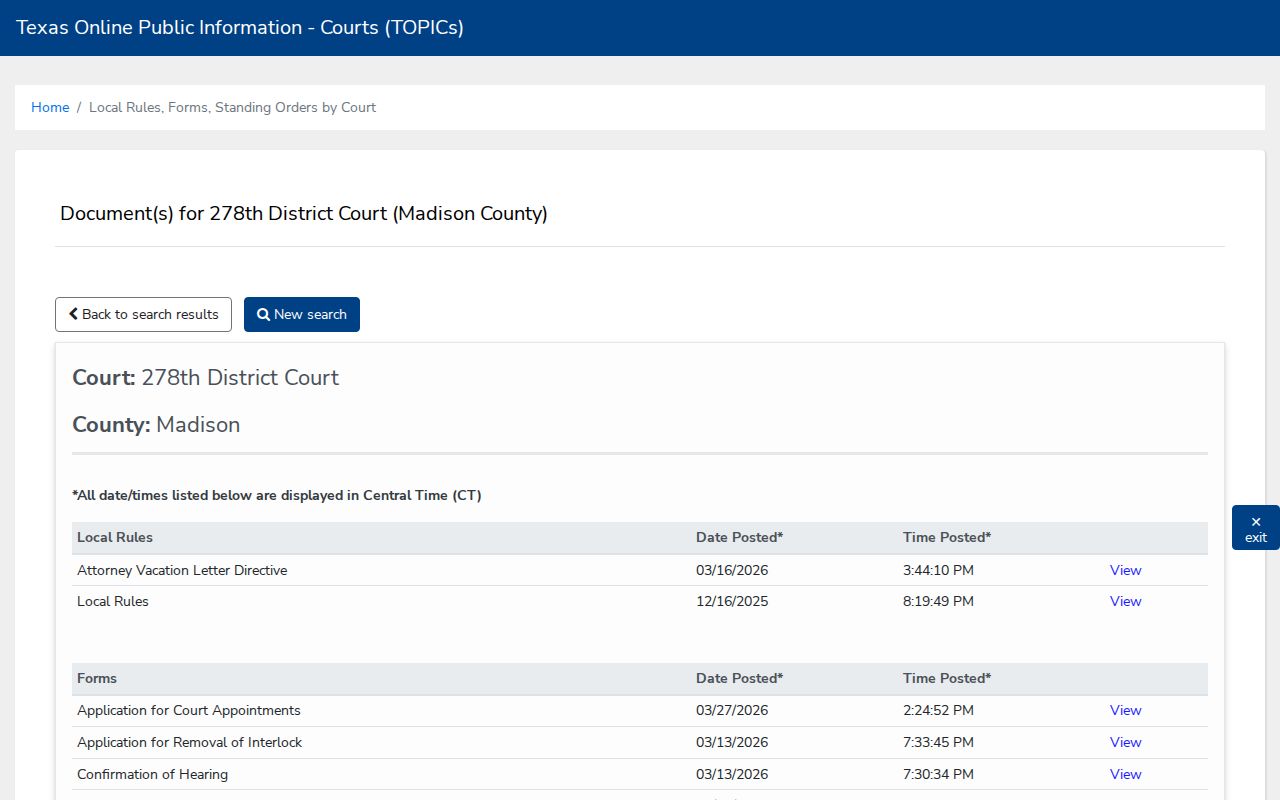
The captured inventory makes local procedure visible while keeping the distinction between court-wide orders and an individual case file clear.
How a Criminal Case Moves
A Madison County case can begin with an arrest or complaint, but the prosecutor decides what charge is filed. A felony may proceed by grand-jury indictment in the 12th or 278th District Court. County-level misdemeanors take the county court route. At arraignment, the accused receives the filed charge and enters a plea. Discovery and motions then build the record before a negotiated plea or trial. The court's judgment and sentence control the final disposition, while later community-supervision, revocation, or appeal entries can extend the file.
Case flow: Charges Filed › Arraignment › Pretrial › Plea or Trial › Disposition › Sentencing
Do not treat each step as proof of the next. A booked accusation may be rejected or replaced, and a filed case may end without conviction. Check the current docket and signed judgment.
Madison County Discovery Orders
A coordinated standing discovery order posted in December 2025 gives Madison County criminal court cases a concrete local procedure. It addresses witness lists, defendant statements or confessions, notice of other alleged offenses, and inspection of seized items under Texas Code of Criminal Procedure Article 39.14 and evidence rules. Discovery is the exchange of case material for litigation. It is not a general public-record entitlement, so a member of the public cannot demand the defense's discovery set from the clerk merely because a docket is open.
A second local order draws another line. Presentence investigation reports are generally nonpublic under Article 42A.256, and CSCD supervision case files are confidential under 37 Texas Administrative Code §163.67. The order allows narrow litigation access in certain revocation or adjudication matters and requires safeguards. Thus, an open judgment may state that community supervision was imposed while officer notes, treatment details, and supervision files remain closed.
Madison County Court Versus DPS
A clerk's criminal court file and a Texas DPS history answer different questions. The Madison County judgment explains what happened in one cause. The DPS public conviction search reports public Texas convictions and deferred adjudications that reached the state repository. It is a name search, not a fingerprint-confirmed identity match, and it can miss a disposition because of reporting lag, spelling, aliases, or data differences.
- Disposition
- The court's recorded resolution of a charge, which may include dismissal, plea, verdict, or another final action.
- Deferred adjudication
- A court outcome in which judgment is deferred while the person completes court-ordered terms.
- Presentence report
- A protected report prepared to aid sentencing, not a routine public docket exhibit.
- Certified copy
- A clerk-authenticated court document used when an ordinary screen print is not enough.
If DPS seems wrong, get the certified Madison County disposition first. That document identifies the court outcome that should be matched to the state arrest cycle.
Case Record Access & Restrictions
Texas treats court records differently from executive-agency files requested under the Texas Public Information Act. Ask the clerk for filed Madison County case documents under court-record procedures. Government Code Chapter 552 is the better route for a sheriff incident report. Article 39.14 governs litigation discovery and does not turn the prosecution's whole discovery file into a public clerk record.
Sealed cases, expunged information, juvenile material, protected victim or medical details, presentence reports, and confidential CSCD files may be withheld or redacted. Online views can be narrower than the paper file. When a Madison County criminal case does not appear, contact the correct clerk and give a cause number, name, and approximate filing date. Ask whether the matter belongs to a district, county, municipal, or Justice court, and whether an older file requires staff retrieval.
The official Madison County Court page confirms the county-level court route. A missing web result is not proof that no case exists, and a sealed record is not made public through a counter request.
Note: Verify a criminal case outcome with the signed judgment, not a booking label or a name-only DPS match.